Showing posts with label free markets. Show all posts

Monday, May 19, 2008

Viva la Regulacion?

Many of my musings over the last several months (again sorry for that brief hiatus) concerns attempts to legislate our way out of the Credit Crisis. Since I rarely attempt to match wits with someone that has an British accent, I defer to an article in this week's Economist, which succinctly argues the success of the current financial system and the danger of the alternatives.

Here are few of the highlights:

As this week's special report on international banking makes clear, the main structural causes of trouble—the collective misjudgment of risk; a zealous search for yield; and the failure of oversight—are deep-seated. In financial history they crop up time after time. Financiers are rightly rewarded for taking risks, which by their nature cannot be entirely managed away or anticipated. The tendency for success to breed complacency and recklessness is as ingrained in financial markets as it is in any other walk of life. However bankers are paid, they cannot just sit out a credit boom; they have to keep dancing. Regulators lack the knowledge, the clout (and often the talent) to keep up with the banks' next brilliant scheme.

That reads like an indictment, until you consider the alternatives. Western finance, to paraphrase Churchill, is the worst way to allocate capital, except for all those other forms. It is obviously better than the waste and dysfunction in China, where centrally planned capital is dished out to the well-connected. But it is also better than the financial system the West used to have. Thanks to the astonishing innovation of the past few decades, derivatives can help firms and investors to hedge risks (there are plenty of Chinese manufacturers who would be grateful for an easy way to soften the impact of exchange-rate shifts). Securitisation widens access to capital for borrowers and to assets for investors: it can finance everything from water utilities to film studios. Leverage brings more lazy companies within reach of determined investors and more homes within reach of poorer consumers.

It is true that financiers have enjoyed vast profits—and the vast salaries that go along with them (pay at American investment banks has been nearly ten times the national average). But the collapse of the credit bubble will bring that down. And despite all the disasters, there are signs of finance's resilience. In the past few months the banks have commanded enough confidence to raise $200 billion in new capital from investors. Bear Stearns and Northern Rock were calamities, but rare ones, because the vast overall losses were spread far and wide. This time, there has been no industry-wide government recapitalisation. After 20 years of growth, the flaws of modern finance are painfully clear. Do not forget its strengths.

The Newest Thing Congress Will Regulate

Today's WSJ, has an article that discusses a bond known as the PIK-toggle. The article explains that the PIK-toggle (payment-in-kind) is allowing companies that issued these bonds to turn off the cash interest payment and replace it with more debt.

This means that $100 of interest income you expected to get will come in the form of $100 of additional bonds. Or in personal terms, its like having a $1000 credit card bill but instead of paying that $100 bill you just send your envelope back to the card company with a note that says "I'm short on cash this month IOU sometime in the future." Private Equity firms inserted the PIK-toggle provision in lending agreements to preserve cash in times of credit crises such as the one we find ourselves in today. The use of the PIK speaks to the severity of the cash crisis since compounded interest will cost these firms more in the long run.

I'm sure that Barney Frank already has drafted a bill to outlaw the PIK as well as force PE firm CEO's to wear chicken suits as just compensation for being smarter than everyone else. In all seriousness though, I expect Congress to weigh-in based on its incessant need to legislate that which it does not understand.

Friday, April 11, 2008

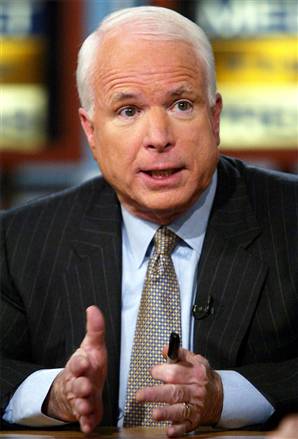
McCain caves in

To date I have been impressed with John McCain. He has been consistently conservative on all the big issues, but yesterday he veered from the straight and narrow path. So much for straight talk, at least on this issue:

John McCain called for an aggressive federal government role aimed at stabilizing the housing market, rejecting a largely hands-off approach he outlined two weeks ago.

The likely Republican presidential nominee's prescription included a heavy dose of policy more typically associated with Democrats, as he sought to show voters he understands their economic pain. Most significantly, he urged the federal government to guarantee new mortgages for homeowners at risk of foreclosure.

The plan "offers every deserving American family or homeowner the opportunity to trade a burdensome mortgage for a manageable loan," he told New York-area small-business owners Thursday.

The plan's price tag is estimated at anywhere between $3 billion and $10 billion.

Ugh...$10 billion in government spending -- especially spending that encourages risky behavior -- is not what the doctor ordered to treat an ailing economy. McCain was right when he first talked about this issue. The economy is correcting itself. There must be some pain before the ship can be righted. Clearly, John McCain's political advisers got to him, and that, frankly, is lame.

Memo to McCain's political team: let McCain be McCain. His gut reaction was right. The nansy pamby politicos who are scared of their shadow are wrong.

Wednesday, March 26, 2008

Barney Frank meet your new best friend Hank Paulson

The Wall Street Journal is reporting that Hank "Bailout King" Paulson delivered a speech today to the Chamber of Commerce urging new regulation of Wall Street. First of all, Hank apparently never took a public speaking course that emphasized the know your audience credo. Why do you deliver a pro-regulation speech to the US Chamber of Commerce? Was he trying to see how few rounds of applause he could get? But then again why would you orchestrate the most massive government intervention in the financial markets in our history?

The only hope we have at this point is that this speech is a way to preempt congress from instituting burdensome new regulation. I get the funny feeling that this is not the case. Paulson is the former CEO of Goldman Sachs and I've been a supporter of his until the three months or so. This speech just reinforces my idea that its time for Paulson to step down and return to his roots. He's obviously been drinking too much water from the Potomac and has forgotten what it takes to remain the most competitive and innovative financial market in the world.

It is absolutely imperative that we maintain this competitive advantage. Our financial expertise is a major factor contributing to our economic might and makes up the vast majority of US GDP. Per the State Department's website:
Services produced by private industry accounted for 67.8 percent of U.S. gross domestic product in 2006, with real estate and financial services such as banking, insurance, and investment on top.

Regulation is not the means by which to maintain the advantage.